Have Query ? Reach Out Us!

Home / Blogs / How Certificate Legalization Can Open Global Opportunities?
12 Mar , 2026
How Certificate Legalization Can Open Global Opportunities?
Certificate legalization acts as the silent bridge between your international dreams and their fulfillment. The formal step will verify that your documents are genuine and sourced from reputable sources.
With proper authentication, it gives foreign institutions, companies, and government bodies confidence to accept your applications. When documents are correctly authenticated for overseas use, you avoid frustrating delays. Moreover, it will prevent application rejections and unexpected issues during visa interviews.
Anyone who is going to study, work, migrate, or conduct business abroad will eventually need a Certificate of Legalization. Every country has its own verification system. This could be whether a Hague Convention Apostille or the full embassy legalization of degree credentials.
This blog takes you through the process in clear, easily understandable language. It shows how attested documents unlock real global opportunities. Also, identify situations where professional help will save money, time, and peace of mind.
Legalization of a certificate shows that your documents are authentic and valid for use in another country. It creates an official bond between your country's administrative offices and the country of destination.
All these are achieved through an approved stamp and certification. When this is done, authorities of another nation can act on your documents without them having to verify everything.
This procedure is a necessity in many instances. It supports student visas, work permits, permanent residence, citizenship procedures, and international trade. A thorough certificate legalization for international usage can deliver big. The process helps legally recognize all your vital records in that foreign jurisdiction.
The route your document takes for legalisation depends entirely on the country you are headed to. For nations that were signatories to the Hague Convention, a simplified apostille process applies. Those outside the convention must rely on the traditional embassy attestation.
Knowing which path applies to you saves you time and lets you avoid mistakes.
| Applicable Countries | Countries that signed the Hague Convention (over 120 nations) | Countries not part of the Hague Convention |
| Issuing Authority | Designated competent authority (usually MEA or equivalent) | Home country authorities plus destination country embassy/consulate |
| Number of Steps | Fewer steps; single apostille certification after MEA | More steps; requires embassy or consulate stamp after MEA |
| Processing Time | Usually faster (a few days to 1-2 weeks) | Longer (several weeks or more) |
| Cost | Generally lower due to fewer stages | Higher due to additional embassy fees and processing |
| Document Format | Standardized apostille certificate attached to the document | Multiple stamps and seals from different authorities |
| Recognition | Automatically recognized in all Hague member countries | Valid only in the specific country whose embassy attests it |
| Complexity | Simpler and more streamlined | More complex with country-specific requirements |
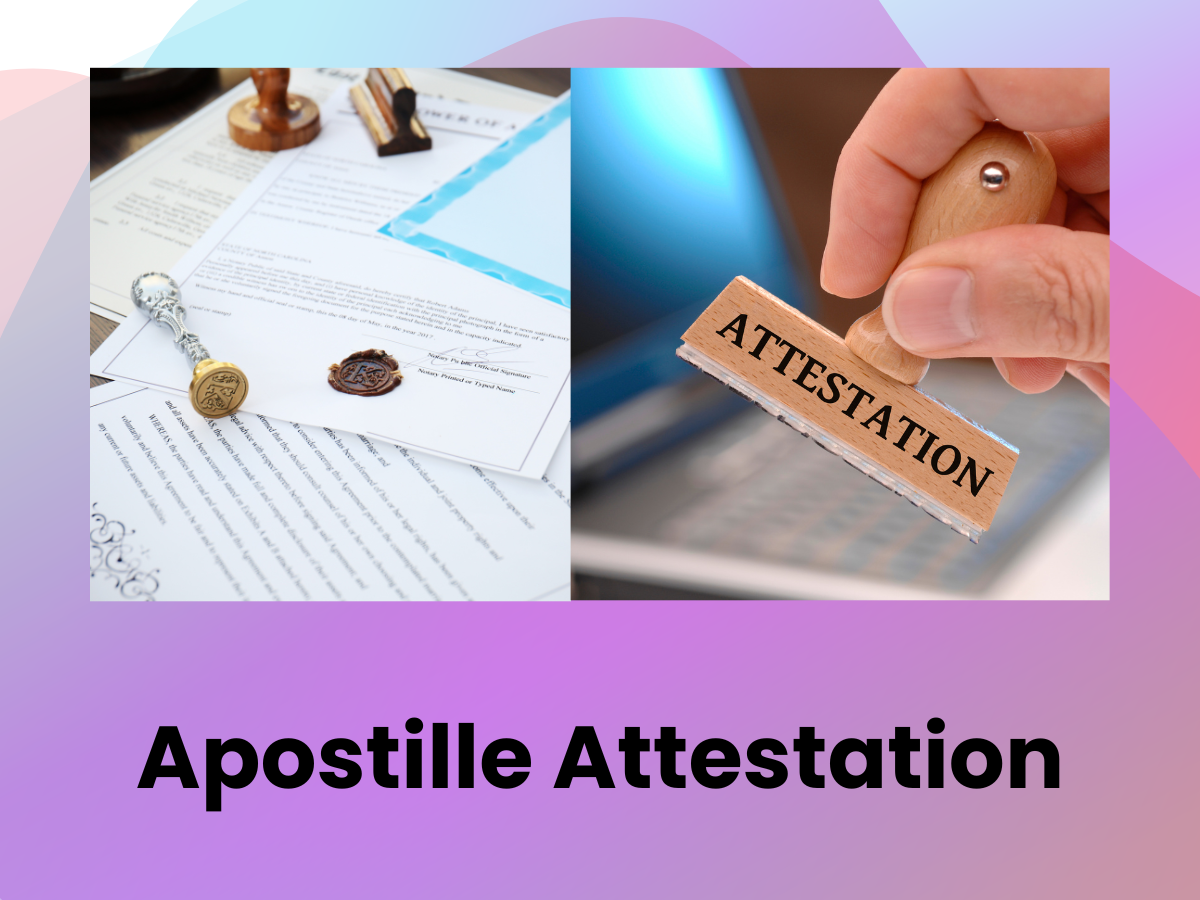
An apostille for a record is a single, uniform certificate that verifies the signature, seal, and authority of the document issuer. If your destination country is not a Hague member, full legalization will require the document to undergo several steps.
The path will include local offices, national authorities, and finally the foreign embassy. Where Hague Convention apostille routes bring speed and simplicity, full embassy legalization requires patience and extra investment.
Properly legalized documents have international credibility. Foreign institutions, educational bodies, employers, and financial institutions can handle them with confidence. This naturally expedites your journey through any verification and approval processes.
Authenticated papers remove doubts about your background. Also, they authenticate your academic credentials, work experience, and the legitimacy of your organization. Foreign systems can draw on your real qualifications rather than question your documentation.
In this way, attestation to international standards opens up global opportunities.
Most international universities require an apostille or its equivalent for educational papers. They have to ensure that your academic records, certificates, and degrees are from valid institutions. Good Certificate Legalization makes these validation processes smooth and efficient.
Well-organized documentation helps prevent stress when meeting enrollment, authorization, and registration deadlines. It eliminates missed terms or delayed acceptances due to rejected paperwork.
An apostille on a diploma or other record may be the difference between a smooth start to your program and a year-long postponement.
Overseas employers require verification of your skills and professional background. Most of them require embassy legalization of degree certificates, professional licenses, and, at times, criminal background checks. These requirements protect their operations and ensure regulatory compliance.
Having pre-legalized documents adds credibility and shows more preparedness in an application. It opens more job markets, smooths employer transitions, and simplifies visa upgrades. This lays the solid ground required for career upgradation, promotions, and international postings.
Immigration departments usually require several documents to be legally authenticated. These may range from vital records, such as birth and marriage certificates, to educational records with apostilles.
They may also include legalized police or criminal background checks. Each item confirms something different about your identity, family ties, and legal status.
Full legalization thereby smooths the process for residence or citizenship applications. Officials believe that your country has already vetted you. So re-verification is less necessary. The possibility of delays or refusal due to missing or unconfirmed documentation is lowered.
Companies operating internationally must obtain a Certificate of Legalization to establish trust. Documents related to corporations are usually required to be legalised before foreign banks and regulatory authorities will accept them. This is a vital factor concerning large-value transactions and regulated industries.
With properly authenticated corporate materials, you can establish banking relationships and sign agreements. Also, they can allow you to pursue procurement opportunities across borders. This makes market exploration easier and supports growth securely. Legalized business documents express professionalism and regulatory compliance at the outset.
Most people will consider academic credentials and vital statistics. This list of documents, which may have to be legalized, is quite long. For simplicity, these can be grouped into three categories: educational, personal, and commercial.
Planning will allow you to collect everything in one go, thereby saving the need for multiple visits to government offices or service providers.
The following are some of the standard documents that require Certificate Legalization:
Having your Educational documents apostilled or undergoing similar legalization provides international validity for your qualifications. This allows foreign universities, employers, and licensing authorities to verify them with ease.
Individual records that may need legalization include:
These are usually needed for dependent visas, legal name changes, inheritance proceedings, and identity verification. Legalization makes them valid in the eyes of foreign authorities.
Business and legal documents generally include:
Properly legalized business documentation opens doors to foreign legal systems, banking networks, and official databases. They confirm that your organization and its activities are documented adequately at home.
While the process may appear complicated, it becomes achievable by being broken down into clear phases. Typically, your documentation progresses from low-level verification to higher levels of government. Each verification level adds another layer of credibility.
Knowing this process helps you to gather appropriate materials at the proper times. This makes it clearer when bringing in professionals can be advantageous.
The first step is usually performed by a notary who is the original issuing organisation. Then, the notary checks the authenticity of the document and the applicant's identity. Afterwards, it is sealed with the notary's signature and seal.
Educational institutions, universities, or municipal authorities sometimes carry out this initial check. The objective remains the same: to demonstrate that the document is genuine and consistent with official records.
The documents are then sent to the provincial or regional administrative department. The possible departments may include a home affairs office, an education ministry, or another similar agency. Officials here verify that the notary, institution, or university is authorized correctly and in active status.
Their certification connects the document to the upper levels of government. This step is vital because many foreign affairs ministries will not accept documents unless they have the proper provincial attestations.
After verification at the provincial level, most nations require a review by their international affairs ministry or any equivalent central authority. This step confirms that prior endorsements and signatures are authentic and duly registered.
The national-level certification then prepares the document for international use. In many systems, you cannot get an MEA apostille or a diplomatic stamp without completing this phase.
The last step would vary, however. Documents meant for Hague member countries are apostilled. This standard authentication verifies the previous authentication through the chain. It makes the former valid in other member countries.
For non-Hague countries, the documents are sent to the diplomatic mission or consulate of the respective country. The representatives review the foreign affairs certification and then add their official endorsement.
Once this embassy legalizes your degree or other documents, they become usable in that country.
Legalization requirements for certificates vary by country and document type. Add specialized needs, such as notarized translation for immigration, and the process can become much more complex. Professional providers guide you through these variables without slowing your progress.
They know which route each destination requires. Whether it be an apostille for a diploma, full consular legalization, or a combination of several methods. Their experience eliminates the guesswork. They free you to focus on your objective:
Some mistakes happen more frequently and may cause significant delays:
Avoiding such errors saves time, resources, and effort. Expert advice can detect such risks well before your application reaches any authority.
Proper Certificate Legalization has real benefits, as it flows smoothly through your plans and procedures.
In short, legalized documentation is prepared for future needs, continuing to support you at every step as you pursue new international goals.
This is especially prudent when outcomes matter.
Professionals turn what could be a multi-step, cumbersome process into a smooth, guided one. With expert help, certificate legalization becomes a practical process. It becomes a manageable solution rather than an intimidating obstacle.
Certificate Legalization acts as your essential link to international opportunity. It turns ordinary documents into verifiable proof. Educational institutions, employers, and government bodies across the globe recognize them without hesitation.
Consider whether you need an apostille for a diploma, embassy legalization of degree credentials, or a notarized translation for immigration. This process removes barriers to studying, working, migrating, or expanding your business overseas.
Don't let administrative delays baffle you. Genuine Attestation Services provides for quick, efficient Certificate Legalization in India. We offer round-the-clock support and pan-India offices.
Log on to our website today and start your journey into global opportunities.
Have Query ? Reach Out Us!
Recent Post
Have Questions ?
Our Client Care Managers Are On Call 24/7 To Answer Your Question.




.png "https://genuineattestationservices.com/storage/blog/1685899152-Education Document Attestation (1).png")






.png "https://genuineattestationservices.com/storage/blog/1690283535-degree attestation (396 × 250 px).png")


.jpg "https://genuineattestationservices.com/storage/blog/1701065263-Qatar education attestation in delhi (1).jpg")